|
|
|
|
|
|
We have the high performance low frequency antenna that you've been looking for!
Specializing in antennas for reception applications below 530 KHz:
Just can't hear the weak station on your radio? These directional antennas will greatly boost reception. Detects the magnetic field part of the radio wave for strongest reception indoors or outdoors.
There are many low-power signals in the longwave band so what you need is a good antenna to hear them! We offer several models of antennas that allow you to peak up the desired weak signals in various bands below 530 KHz. The antennas will also cut interference because they are directional.
Specialty antennas for geological research, low frequency communications, radio astronomy, ionospheric research, lightning detection, longwave reception.
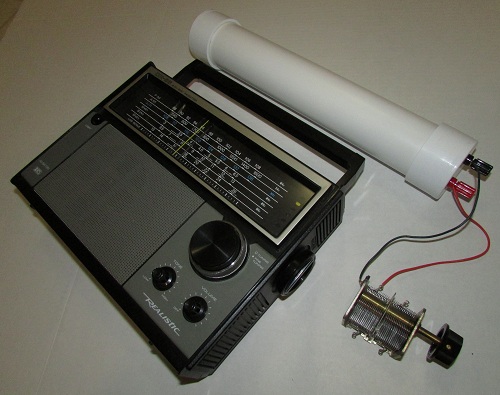
Antennas are easily tuned across 2 binding posts via an external capacitor.
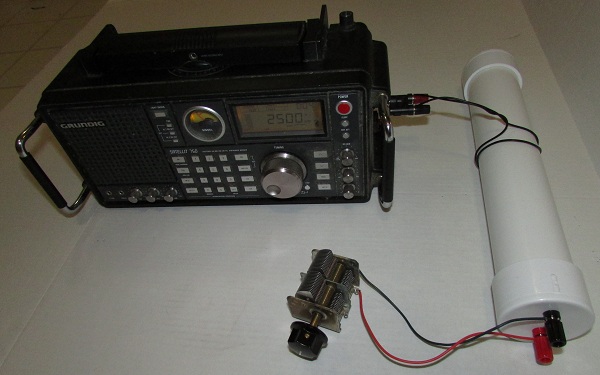
Ultimate in impedance matching: To match a 50 ohm load or 75 ohm load or 150 ohm load then just wind a few (2 to 7) turns around the outer case. Match any radio's input impedance - allows perfect peaking of signal level into your receiver.
Antennas also offer high impedance output for driving FET's or tubes, signal can be pulled off antenna in two ways.
Some antennas (the ELF ones) offer wideband output and high impedance for maximum signal pick up, though can also be user-tuned if needed.
Sales to USA only.
Antennas for the frequency range of 150 KHz - 1 MHz
Have a long wave radio and don't get much or any reception? Greatly boost performance with these directional antennas!
There are many low power navigation beacons in the long wave band. These have transmit powers less than 100 watts. You'll need a good antenna to hear them!
International long wave AM broadcasts can be heard between 150 KHz to 270 KHz, when conditions are right, near coastal areas of USA.
Sales to USA only.
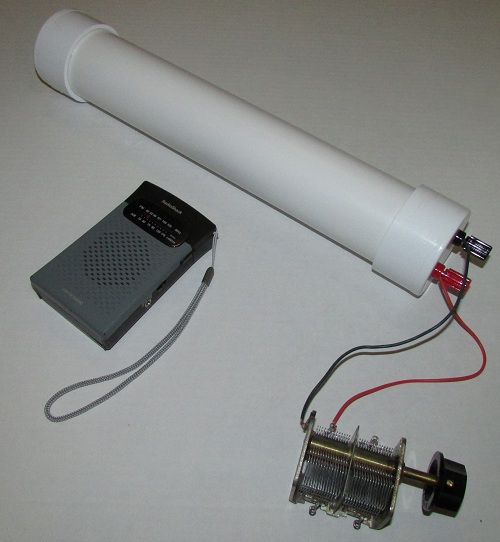
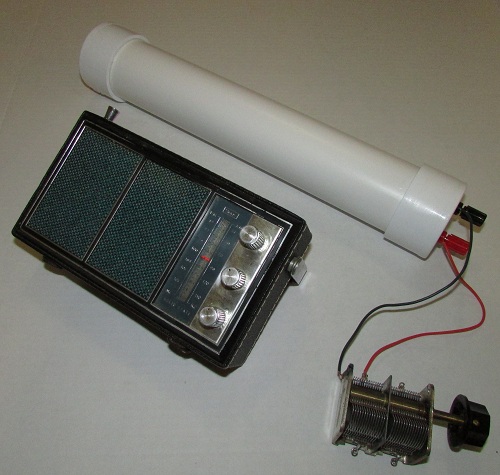
Do you have an antique longwave transistor radio that has weak reception? Use this antenna to boost reception greatly! Just tune the antenna and lay your antique pocket radio near the center of the antenna to get a great boost in signal strength. No need to connect anything up to the radio. The antenna concentrates the radio wave magnetic field much like a magnifying lens gathers up and focuses light. The signal is greatly magnified and concentrated by the antenna.
Need to tune just a single channel frequency? Just place a fixed-value capacitor across the antenna's connections to set the receive frequency.
NOTE: This antenna MUST be tuned to the desired station. Antenna has a narrow bandwidth to help cut adjacent channel interference so you must retune the antenna when changing stations. Antenna can be fix-tuned to a single favorite station with a fixed-value capacitor in the range of 100 pF to 384 pF. You will have to experiment to find the value needed for your favorite station. Just parallel individual capacitors across the binding posts until maximum signal strength is obtained. (Radio Shack has a grab-bag of about 100 quantity of "pF" range 'ceramic disc' capacitors for under $ 5.00). Great for permanently tuning in WWVB 60 KHz or other single LF station of interest.
Great boost in signal strength results when antenna is tuned to desired station.
Antennas for the frequency range of 30 KHz - 220 KHz
Designed for weak signal reception. Tunes range with 0 to 384 pF capacitor sold separately.
Sales to USA only.
Super-charge your radio!
Have weak reception with your current antenna? Use these new antennas to boost reception greatly!
Need to tune just a single channel frequency? Just place a fixed-value capacitor across the antenna's connections to set the receive frequency.
NOTE: This antenna MUST be tuned to the desired station. Antennas have narrow bandwidths to help cut adjacent channel interference so you must retune the antenna when changing stations. Antenna can be fix-tuned to a single favorite station with a fixed-value capacitor in the range of 100 pF to 384 pF. You will have to experiment to find the value needed for your favorite station. Just parallel individual capacitors across the binding posts until maximum signal strength is obtained. (Radio Shack has a grab-bag of about 100 quantity of "pF" range 'ceramic disc' capacitors for under $ 5.00). Great for permanently tuning in WWVB 60 KHz or other single LF station of interest.
Great boost in signal strength results when antenna is tuned to desired station.
Antennas for the frequency range of 3 KHz - 50 KHz
Designed for weak signal reception. Tunes range with 0 to 384 pF capacitor sold separately.
Sales to USA only.
C22T-3K-6K-BC is also usable in wideband mode to detect Tweeks and Whistlers and other audio-range natural AC magnetic fields down to 1 KHz and up to 6 KHz. Use an audio pre-amplifer having high impedance (greater than 15,000 ohms), and bridge the antenna with a 10 K-ohm resistor to widen the band.
Have weak reception with your current antenna? Use these new antennas to boost reception greatly!
Need to tune just a single channel frequency? Just place a fixed-value capacitor across the antenna's connections to set the receive frequency.
NOTE: This antenna MUST be tuned to the desired station. Antenna has a narrow bandwidth to help cut adjacent channel interference so you must retune the antenna when changing stations.
Great boost in signal strength results when antenna is tuned to desired station.
AF22T is 24 inches long.
Antennas in this range are useful for research and specialized remote sensing applications.
Sales to USA only.
For experimental and research applications.
"AF" prefix antennas are tunable over a wide range with an external fixed value capacitor.
A capacitor value of @ 100 pF tunes to @ 3 KHz. Self resonate at @ 4 KHz.
A capacitor value of @ 47000 pF tunes to @ 200 Hz, minimum recommended operating frequency.
NOTE: These antennas have output impedances over 50,000 ohms at resonance peak.
1.6 KHz. Ionospheric propagation cutoff frequency. Lowest frequency for tweeks. 1.6 KHz is the lowest frequency at which radio waves will travel through the earth-ionosphere waveguide cavity. No lightning static through the air is heard below this frequency. However reception via upper ionospheric ducting (propagation between 2 ionospheric layers above the D-layer) is possible.
1.0 KHz. 1 KHz radio waves propagate through the earth. 1 KHz is 600 Hz below the ionospheric cutoff frequency of 1.6 KHz, so 1 KHz does not travel very far through the "air". Propagation is mostly underground, not through the "air". However reception via upper ionospheric ducting (propagation between 2 ionospheric layers above the D-layer) is possible.
330 Hz. Research applications. This radio wave frequency has an approximate 550 miles wavelength. Propagation for any great distance is underground through the earth, not through the "air".
AF22T is 24 inches long.
Antennas in this range are useful for research and specialized remote sensing applications.
Sales to USA only.
For experimental and research applications.
"AF" prefix antennas are tunable over a wide range with an external fixed value capacitor.
0 pF tunes to @ 300 Hz.
1000 pF tunes to @ 180 Hz.
0.22 uF tunes to @ 12 Hz.
3.9 uF tunes to @ 3 Hz.
NOTE: These antennas have output impedances over 50,000 ohms at resonance peak.
AG22T is 24 inches long.
Antennas in this range are useful for research and specialized remote sensing applications.
Probably as low as you can go in radio frequency, this antenna receives 0.1 Hertz thru 10 Hertz.
Sales to USA only.
For experimental and research applications.
DC impedance is @ 16 K-ohms. Antenna's resistance will change up or down when a slow magnetic field (below 1 Hz) is applied, or if antenna moves in earth's magnetic field, or if earth's magnetic field moves. Great for detecting geomagnetic storms. You can also spin this antenna slowly once per second (just like a radar antenna) and use a wireless data link and get a sine-wave representation of earth's magnetic field strength. Antenna moving thru earth's magnetic field generates a strong signal voltage (0.3 volt) in the antenna.
For use below 10 Hz, this is a generally a broadband ELF antenna, but it can be slightly tuned.
0.1 uF tunes to @ 8 Hz. Tuning is not sharply defined.
0.22 uF tunes to @ 6 Hz. Tuning is not sharply defined.
3.9 uF tunes to @ 1.5 Hz. Minimum limit for tuning, not sharply defined.
NOTE: These antennas have output impedances over 50,000 ohms at resonance peak.
Lightning Detection Antenna for the frequency range of 2 KHz - 20 KHz
D6T-3KC-BC is a long range cloud-to-ground lightning detection antenna. This 9 inch long antenna can be tuned between 2 KHz to 20 KHz with external capacitors. Designed for use in the VLF-Low lightning detection band of 2 KHz - 20 KHz. Tunes @ 3 KHz when an 0.02 uF capacitor is placed across terminals. Use a polyester or polypropelene type capacitor for highest gain. For use in long range lightning detectors for sensing cloud-to-ground lightning strikes up to 300 miles. See our lightning detector project link below on this page.
A 400 pF capacitor placed across the D6T part # antenna terminals will tune to approximately 20 KHz.
A 1000 pF capacitor placed across the D6T part # antenna terminals will tune to approximately 14 KHz.
A 2000 pF capacitor placed across the D6T part # antenna terminals will tune to approximately 10 KHz.
An 0.01 uF capacitor placed across the D6T part # antenna terminals will tune to approximately 4 KHz.
An 0.015 uF capacitor placed across the D6T part # antenna terminals will tune to approximately 3.5 KHz.
An 0.02 uF capacitor placed across the D6T part # antenna terminals will tune to approximately 3 KHz.
An 0.03 uF capacitor placed across the D6T part # antenna terminals will tune to approximately 2.5 KHz.
An 0.047 uF capacitor placed across the D6T part # antenna terminals will tune to approximately 2 KHz.
Exact tuned frequency with external capacitor may vary +/- 1 KHz depending on individual antenna. Adjust capacitor value to obtain desired frequency value.
Lightning Detector project 11.
ELF Extremely Low Frequency Receiver. project 12.
Sales to USA only.
EXAMPLE USE:
These antennas detect the magnetic field part of the VLF or LF radio wave. This field is strongest near ground level so do not mount the antennas high in the air. Simply 5 feet above ground will do the trick. The antenna will also work indoors in most cases and can even work underground, especially the VLF and lower frequency antennas.
You can tune the antenna simply by placing a variable or permanent-value capacitor across the binding post connectors. Examples for min-max values for this capacitor are shown above on this page with the antenna models.
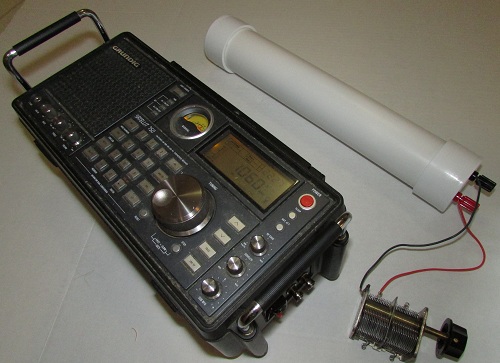
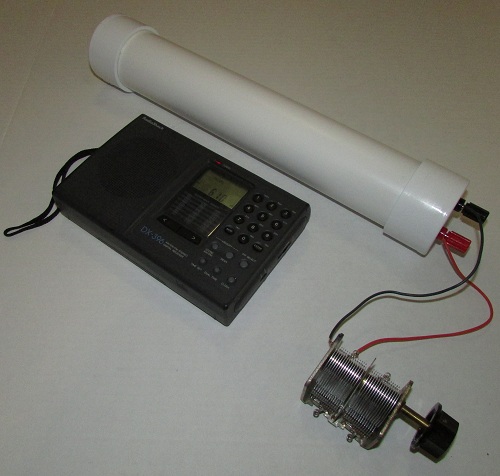
Most portable longwave radios have a built-in bar-core antenna that will very easily pick up the strong magnetic field from this antenna.
Simply place the (top) of the portable longwave radio near the antenna, and tune capacitor until the signal gets louder and stronger. Results should be -very- dramatic.
Rotate radio and ANTENNA for best reception.
This keeps the antenna isolated to prevent noise pickup:
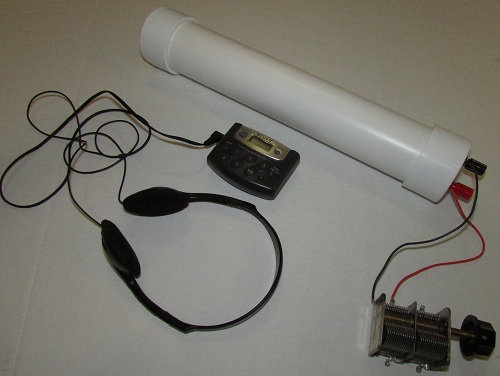
Wrap 4 turns of wire around the center of the antenna's outer plastic case. Connect these wires (with some coaxial cable or other antenna cable) to the radio's antenna and ground terminals. Adjust tuning capacitor across antenna's binding posts for strongest signal. Add or subtract wire turns on antenna's outer case until signal strength does not increase further when re-peaked each time after adding or subtracting one turn at a time. The point where signal strength does not increase further is the correct match point for your radio.
These antennas are usually for use below 1000 Hz.
Connect antenna directly to equipment's high Z input jack. Equipment should have JFET or FET input, or an input impedance of about 1 meg ohm. Most oscilloscopes and some test equipment have this type of input.
A tuning capacitor can be placed directly across the binding posts if applicable to tune the antenna to desired frequency.
High impedance preamplifier for use with antennas having 100,000 ohms output impedance.
You can greatly boost signal gain by using a pre-amplifier if your equipment does not already have a high impedance input. "CF" is a capacitor that controls frequency. Typical values are shown above on this page. Q1 is 2N3904 NPN transistor. R1 is 470 K-ohms. R2 is 1000 - ohms. R3 is 10 K-ohms. C1 is 47 pF. C2 is 0.001 uF.
Supply voltage can be from 3 volts to 12 volts, depending on how much gain you want. Works well at 6 to 12 volts.
Other amplifiers or IC chips or an FET may be more suitable than this sample single transistor example. But, if building this example circuit for the first time, do not substitute the 2N3904.
See below on this page for link to an FET pre-amplifier you can build.
Most test equipment already contains a built-in preamplifier. Just connect antenna directly to equipment input.
When most people hear the words "Radio Astronomy" they think of giant dish antennas pulling down weak star noise from the heavens. Unfortuneately LF waves can not penetrate the upper atmosphere, however other effects can be successfully monitored, especially solar particles and effects of galactic radiation on the ionosphere.
The sun can emit bursts of radiation during solar flares that can affect how radio waves travel in the atmosphere. Signal strengths become greatly increased or completely drop out. This effect can be graphed on chart recorder software. Sudden bursts of gamma-rays and x-rays from outside the solar system (perhaps from black holes or neutron stars colliding, etc) can be detected a few times per year.
You can watch the sunrise every morning on the LF bands! Various frequencies respond differently to ionospheric changes that occur at sunrise. Here are 3 charted examples. Each morning's graph will be different even if the observation frequency is the same.
If you are monitoring the overall static level (from lightning storms), it is best to have the storms more than 300 miles away so that any "outer space generated effects" can be seen. Static from storms over 1000 miles away can be easily heard on VLF-Mid, VLF-Hi, and LF-Low bands. LF-Mid and MF-Low bands come alive at night for DX static reception (for watching the sunrise effect and other space effects). There is always a level of constant static available from all directions depending on the band selected.
The charts below show the overall static level as it changes over time, especially greatly at sunrise, when the normal mix of solar radiation (UV light, X-rays, solar wind particles) hits the ionosphere each morning.
During times of solar flares, the Sunrise Effect may not occur.
This frequency range is now clear for RADIO ASTRONOMY USES. The band LORAN-C used was 90 KHz to 110 KHz.
150 KHz - 530 KHz range antennas. Listen to hemispheric lightning static at night. This range is sensitive to solar activity, reception distance increases greatly at night as the ionospheric D layer fades away. You can monitor various beacon's signal strength level ( or even just the static level like in graph above ) to see effects of day / night and solar activity on signal strength.
60.0 KHz range antennas. Listen to hemispheric lightning static. 3000 miles range. Also hear WWVB 60 KHz Time Signal Station (which can be nulled out by rotating the antenna). Radio waves at this frequency are sensitive to solar activity. Signals better at night.
40.0 KHz range antennas. Listen to hemispheric lightning static. 3000 miles range. Radio waves at this frequency are sensitive to solar activity. Any beacon stations can be nulled out by rotating the antenna. Signals better at night.
20 KHz range antenna. Beacons between 20 KHz to 30 KHz. These powerful beacons (24.0 KHz, 24.8 KHz, 25.2 KHz, 28.0 KHz) transmit 24 hours a day and received signal strength levels are affected by solar flare activity.
15 KHz range antenna. Listen to global lightning static at 15 KHz. Radio waves at 15 KHz can easily circle the globe day and night. Very powerful static levels. Radio waves at this frequency are sensitive to solar activity.
10 KHz range antenna. Listen to global lightning static at 10 KHz. Radio waves at 10 KHz can easily circle the globe day and night. Very powerful static levels. 10 KHz antenna for lightning detection. At times very powerful signals can circle the globe and return to point of origin as "echos". Radio waves at this frequency are sensitive to solar activity.
8 KHz range antenna. Listen to global lightning static at 8 KHz. Static levels are just slightly stronger at night due to better propagation because the ionospheric D Layer disappears. Very powerful static levels, 8 KHz is the lowest frequency for monitoring world-wide lightning static. Monitor the static level on a chart recorder ( USB Chart Recorder Model DI-148U ) just before sunrise to see a trace of the "sunrise effect" on the ionosphere. Sferics suddenly drop off when sunlight first strikes the ionisphere in the morning. 8.0 KHz antenna for lightning detection. Radio waves at this frequency are sensitive to solar activity.
6.0 KHz range antenna. Hemisphere-wide lightning static. Better propagation at night. Hear the larger strikes.
5.0 KHz range antenna. Hemisphere-wide lightning static. Better propagation at night. Hear the larger strikes.
3.0 KHz range antenna. Lightning Detection. Only the biggest strikes are heard below this frequency.
VLF and Longwave Receiver for High Impedance "C" Antennas.
Lightning Detector project 11.
Longwave and VLF Receiver with Signal VU Meter. (working on it) will take a while....as time permits.
VLF Receiver with Signal Strength Meter.
Wideband ULF - VLF FET Pre-amplifier.
Part # (tunes range with 0 to 384 pF) Radio Band Low Freq Hi Freq __Price Longwave Antennas C14T-480K-1000K-BC Beacons - AM 480 KHz 1000 KHz $ 140.00 C14T-260K-530K-BC Longwave - Beacons 260 KHz 530 KHz $ 140.00 C14T-190K-400K-BC Longwave - Beacons 190 KHz 400 KHz $ 140.00 C14T-150K-300K-BC Longwave - Beacons 150 KHz 300 KHz $ 140.00
Part # (tunes range with 0 to 384 pF) Radio Band Low Freq Hi Freq __Price Low Frequency Antennas C14T-100K-220K-BC RFID 134 KHz 100 KHz 220 KHz $ 140.00 C14T-50K-120K-BC WWVB 60 KHz 50 KHz 120 KHz $ 140.00 C14T-30K-60K-BC - 30 KHz 60 KHz $ 145.00
Part # (tunes range with 0 to 384 pF) Radio Band Low Freq Hi Freq __Price VLF Antennas C14T-23K-50K-BC beacons 23 KHz 50 KHz $ 150.00 C14T-17K-40K-BC beacons 17 KHz 40 KHz $ 150.00 C14T-11K-26K-BC beacons 11 KHz 26 KHz $ 155.00 C14T-6K-12K-BC experimental, scientific 6 KHz 12 KHz $ 160.00 C22T-3K-6K-BC whistlers, tweeks, scientific 3 KHz 6 KHz $ 200.00
ULF antennas for 300 Hz to 3 KHz.
Part # Radio Band Low Freq Hi Freq __Price AF22T-300H-3K-BC ULF 300 Hz 3 KHz $ 230.00
ELF antennas for 3 Hz to 150 Hz.
Part # Radio Band Low Freq Hi Freq __Price AF22T-3H-150H-BC ELF 3 Hz 150 Hz $ 299.95
ELF antennas for 0.1 Hz to 10 Hz.
Part # Radio Band Low Freq Hi Freq __Price AG22T-0.1H-10H-BC ELF 0.1 Hz 10 Hz $ 399.95

- Radio Band Low Freq Hi Freq __Price VLF Lightning Detection Antennas D6T-3KC-BC lightning detection 2 KHz 20 KHz $ 85.00
Uses our Lightning Detection Antenna part # D6T-3KC-BC. (Tune this project to 2.5 KHz to 3.5 KHz for best audio result with circuit shown). Or modify project to work at 14 KHz for long range detections.
07-08-2011. NEW! This direct input tuned receiver works with our Model "C" antennas above on this page, in the range of 10 KHz to 530 KHz.
07-16-2011. NEW! Uses our Lightning Detection Antenna part # D6T-3KC-BC.
07-19-2011. NEW! For use with any of our high impedance ELF antennas.
NEED MORE GAIN? OR DON'T HAVE A HIGH IMPEDANCE INPUT?
410 KHz. Sunrise Effect.
Static received all night until sunrise when signals are adsorbed by quickly forming ionospheric "D" layer. Distant reception greater than 200 miles completely blocked by atmospheric adsorbtion during daytime. Solar flares can affect this band.
160 KHz. Sunrise Effect.
100 KHz - LORAN C NAVIGATION SYSTEM IS NOW SHUT DOWN.
8 KHz. Sunrise Effect.
8 KHz waves can circle the globe so the static level is fairly constant at any given time. However a slight effect can be seen at this frequency as the ionosphere goes through changes at sunrise. Overall signal strength is typically less during daytime due to some adsorbtion. Solar flares can affect this band. This band does not seem to be as sensitive (to solar effects) as the higher frequency bands (those above 20 KHz) but more research is needed.
Chart speed 360 seconds per division.
See more charts at bottom of page.
07-08-2011. NEW! This direct input tuned receiver works with our Model "C" antennas above on this page, in the range of 10 KHz to 530 KHz.
Uses our Lightning Detection Antenna part # D6T-3KC-BC.